
Queen Woyzaro Terunesh's
Dress and Silver Slippers (1830-1868)
Cultural heritage of ethiopia
design Details
Queen Woyzaro Terunesh's Dress and Silver Slippers
Amhara people
1830-1868

3D Viewer
Use the mouse wheel to zoom in or out, and drag the right mouse button to rotate the garment.



queen Tiruwork Wube
Queen Woyzaro Terunesh, also known as Tiruwork Wube, was a 19th-century Ethiopian noblewoman and Empress consort as the wife of Emperor Tewodros II. Born into a powerful aristocratic family as the daughter of Dejazmach Wube Haile Maryam, her marriage to the emperor reflected the political tensions of the era and was reportedly troubled. She was the mother of Prince Alemayehu. After the fall of Maqdala in 1868 and the death of Tewodros II, she fell ill and died while traveling under British escort, becoming a symbol of the personal and national tragedies surrounding Ethiopia’s encounter with European imperial forces.
3D avatar garment fitting video
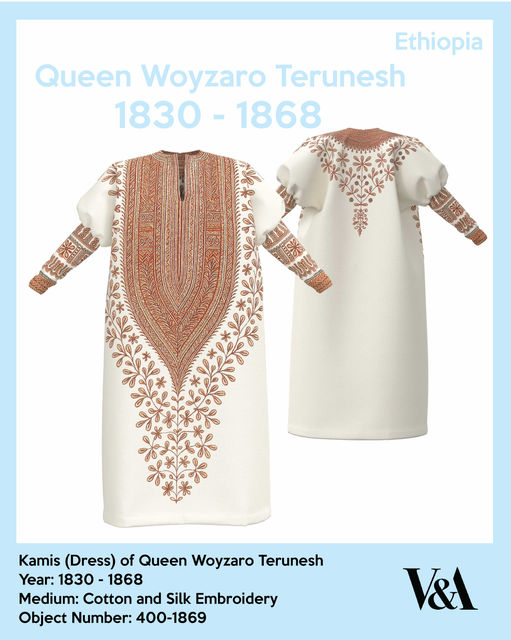
Queen Woyzaro Terunesh's kamis (dress)
Class: Dress
Dimensions: W. 62 In. x H. 49 In. (157.5 cm x 124.5 cm)
Medium: Cotton, Silk, and Chain Stitch
Descriptions: This long-sleeved robe is made of linen woven with subtle stripes and decorated with silk embroidery in red, yellow, black, and green, executed primarily in chain stitch. Embroidery appears around the neckline and cuffs and is organized into successive decorative bands featuring geometric and figurative motifs, including chequered panels, chevrons, stylized scrolls, and occasional rows of veiled female heads. These bands are bordered by a necklace-like motif, beyond which appear open arrangements of circles and slender floriated crosses. The garment is constructed from two layers of soft cotton, enhancing both durability and comfort. Originating from Abyssinia (Ethiopia) and dating to the 19th century, the robe is traditionally associated with royal or elite wear and is recorded as having belonged to the Queen of Abyssinia.
(Source: The British Museum Website)
silver slippers of royalty
Class: Shoes
Dimensions: W. 4 1/8 In. x H. 10 1/32 In. x D 2 3/8 In. (10.5 cm x 25.5 cm x 6 cm)
Medium: Silk, Gold, Silk, Leather, and Copper
Descriptions: These silver slippers are rare examples of royal ceremonial footwear from North or Northeast Africa, dating to the 18th–19th century. Made from hammered silver and decorated with gilded filigree and beaded borders, they were not meant for everyday walking but for court ceremonies and formal appearances, where visible luxury signaled authority. In many African and Islamic royal traditions, precious-metal footwear symbolized sovereignty, ritual purity, and elevated status, with silver valued for its association with cleanliness and protection. These slippers also reflect the skill of Ethiopian artisans and the role of fashion in royal pride and power.
(Source: The British Museum Website)