
Xhosa Woman’s Breast Cloth (1970), Skirt (1966), and Bracelet (1964)
Cultural heritage of south africa
design Details
Xhosa Woman's Outfits
xhosas people
mid 1900s

3D Viewer
Use the mouse wheel to zoom in or out, and drag the right mouse button to rotate the garment.


3D avatar garment fitting video
xhosa woman's breast cloth
Class: Textile - Woven
Dimensions: W. 49 1/4 In. x H. 33 5/8 In. (125 cm x 85.5 cm)
Medium: A Xhosa woman’s breast cloth, often called an inqindi, is a traditional garment worn across the chest as part of ceremonial dress in Xhosa culture of South Africa. It is typically made from softened animal hide or cloth and decorated with beadwork, stitched bands, and red tassels. The garment is worn in non-sexual, cultural contexts such as rituals, celebrations, and rites of passage, and its colors and patterns can communicate age, status, or identity. The breast cloth is usually worn with other traditional garments like umbhaco, umngqa (skirt), and iqhiya (headwrap), forming an important expression of Xhosa heritage and womanhood.
(Source: The British Museum Website)
xhosa woman's skirt
Class: Skirt
Dimensions: W. 37 13⁄16 In. x H. 35 7⁄16 In. (96 cm x 90 cm)
Medium: Textiles and Glass Beads
Descriptions: This skirt is a notable example of traditional dress from the Xhosa people of South Africa, dating to the late 19th or early 20th century. Made from red-dyed cloth, a color closely associated with Xhosa identity, the skirt has a flared form with vertical panels radiating from the waistband. These panels are decorated with beadwork and embroidery in white, blue, and darker tones, creating strong linear patterns. Such skirts were worn for ceremonial and social occasions, and their decoration could indicate age, marital status, or group affiliation. Today, the skirt is preserved as a cultural artifact that highlights Xhosa craftsmanship and the symbolic role of dress in Xhosa society.
(Source: The British Museum Website)
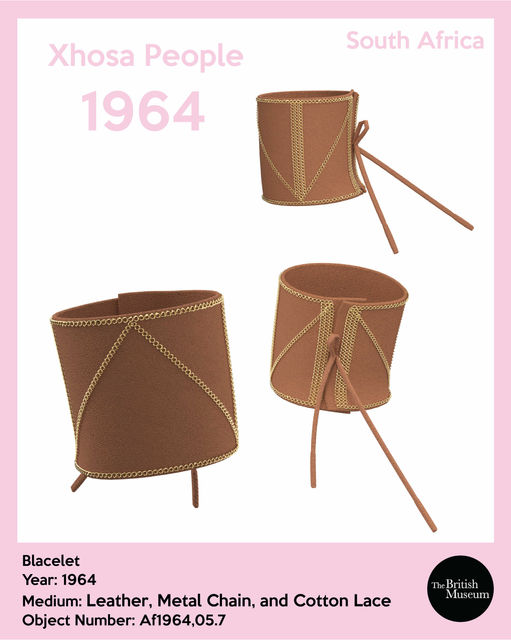
xhosa woman's bracelet
Class: Jewelry - Bracelet
Dimensions: W. 31 1/2 In. x H. 33 1/2 In. (85.1 cm x 80 cm)
Medium: Mud-Dyed Cotton
Descriptions: This bracelet is a well-crafted example of traditional adornment from the Xhosa people of South Africa, dating to the 19th or early 20th century. Made from leather, the bracelet is formed as a cylindrical cuff and fastened with a simple tie. It is decorated with plaited and stitched patterns, creating vertical and diagonal bands that add texture and visual interest. The careful stitching reflects skilled leatherworking traditions closely connected to cattle culture, which held strong economic and symbolic importance in Xhosa society.
(Source: The British Museum Website)
xhosa people
The Xhosa people are one of South Africa’s largest ethnic groups, primarily residing in the Eastern Cape region. They are known for their rich cultural heritage, including traditional beadwork, distinctive clothing, storytelling, and initiation rites that preserve community values and social structures. The Xhosa language, part of the Nguni group, features the characteristic “click” consonants and is a vital element of their identity. Historically and politically, the Xhosa have played a significant role in South Africa, producing leaders such as Nelson Mandela and Thabo Mbeki, and contributing to the country’s struggle against colonialism and apartheid. Their cultural practices, arts, and ceremonies continue to influence South African society, symbolizing resilience, heritage, and communal unity.